Cardiovascular Emergencies
Stroke
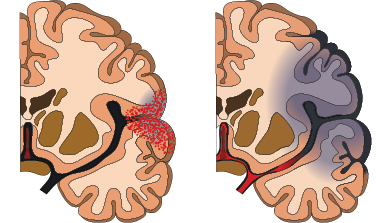
A stroke happens when blood flow to a part of the brain is interrupted either by a blocked artery or by a ruptured blood vessel in the brain. A stroke may cause brain damage, which impairs certain body functions, depending on the part of the brain affected.
The type of stroke cannot be determined without advanced scanning at a hospital. There are two types of strokes:
- Hemorrhagic (blood loss)
- Ischemic (blood clot/blocked vessel)
A Transient Ischemic Attack (TIA) is a temporary disruption of the blood flow to the brain due to a narrowing of an artery in this area. It’s typically of short duration and leaves no permanent damage, but looks exactly like a stroke. Always suspect a stroke, even if the symptoms resolve themselves, as a TIA can be an indication of a pending stroke.
Signs and Symptoms of a Stroke/TIA
Remember the mnemonic F.A.S.T. to check for the signs and symptoms of a stroke and to get immediate help:
- F – Facial droop: Ask the casualty to smile. One side of the face may not move as well as the other side.
- A – Arm drift: Ask the casualty to hold both arms out with the palms up and close their eyes. One arm may not move, or may drift down compared to the other arm.
- S – Speech: Ask the casualty to repeat a phrase you say. The casualty may slur words, use the incorrect words or is unable to speak.
- T – Time: When was the onset of symptoms? Ask the casualty, or their family, friends, or bystanders when the symptoms were first noticed. Get immediate medical help; the earlier a stroke is treated the better the outcome.
Other signs and symptoms of a stroke include:
- Blurred vision
- Sudden confusion
- Dizziness
- Headache
- Loss of balance
It is important that first aid providers do not dismiss the signs and symptoms of a stroke as intoxication.
First Aid for a Stroke
To give first aid for a stroke, perform the following steps:
- Perform a scene survey.
- Perform a primary survey.
- Use F.A.S.T to assess for a stroke.
- Call for medical help.
- Place the casualty at rest in the semi-sitting position.
- Do not give the casualty anything by mouth. Do not give the casualty ASA.
- Give ongoing care.
If the casualty becomes unconscious, place them in the recovery position. If there is paralysis, position the casualty with the paralyzed side up. This will reduce the chance of tissue or nerve damage to the affected side.
 |
 |